

You finish a chapter and the pages glow. It looks like a good session. Then someone asks what the chapter argued, and you reach for the book.
Highlighting is one of the most common study habits, and one of the weaker ones when it is used on its own. A large review of ten learning techniques by Dunlosky and colleagues (2013) rated highlighting and rereading as low in usefulness. Testing yourself and spreading study over time came out on top.
That doesn't mean you should put the marker away. It means the colour can't be the end of the work. A highlight is a bookmark for thinking you still have to do. The trouble is that dragging a marker feels like the thinking itself: your hand is busy, the page changes, and a familiar sentence starts to feel like a known one.
Here are four habits that close the gap. The screenshots use a short text about Einstein's principle of relativity, but any book, article or lecture handout works the same way.
1. Highlight less than you think you should
Colour works by contrast. One marked sentence on a page stands out. Twelve marked sentences are just a differently coloured page, and when you come back you have to read it all again to find what mattered.
A simple rule: read the whole paragraph first, then decide. While you are still in the middle of a sentence, everything sounds important. By the end you can see which line carries the idea and which lines only explain or illustrate it. Mark the one you could say back in your own words.
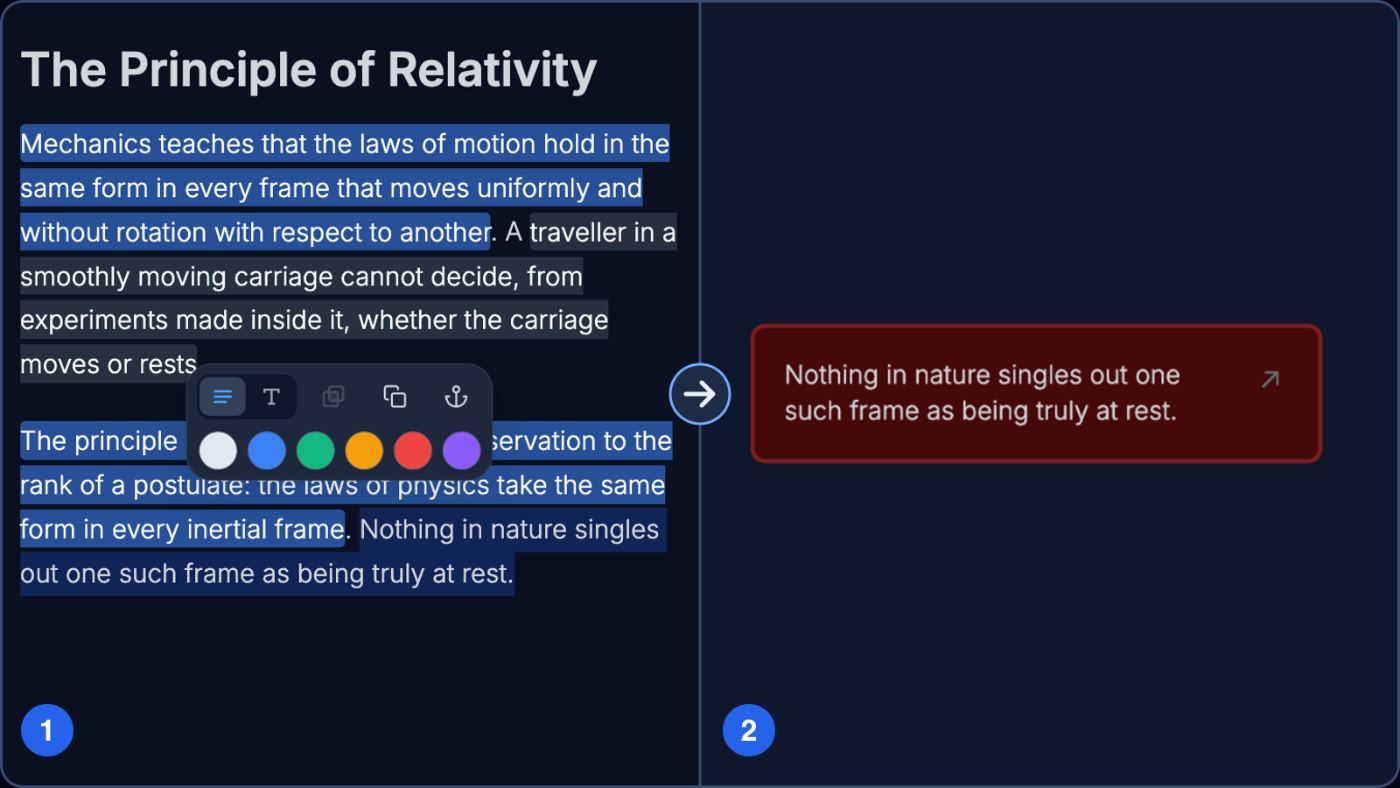
In the example, the paragraph builds up to a single claim: nothing in nature singles out one frame as being truly at rest. That is the sentence worth keeping.
In Nodebook: select the passage and pick a colour. The passage appears as a node on your map, so your highlights collect in one place instead of staying scattered across pages.
Try it: after each page, count your highlights. Then cut them in half.
2. Give every colour a job
Most people pick a colour by mood or by whichever marker is closest. Later, yellow and green mean nothing, so the colours add noise.
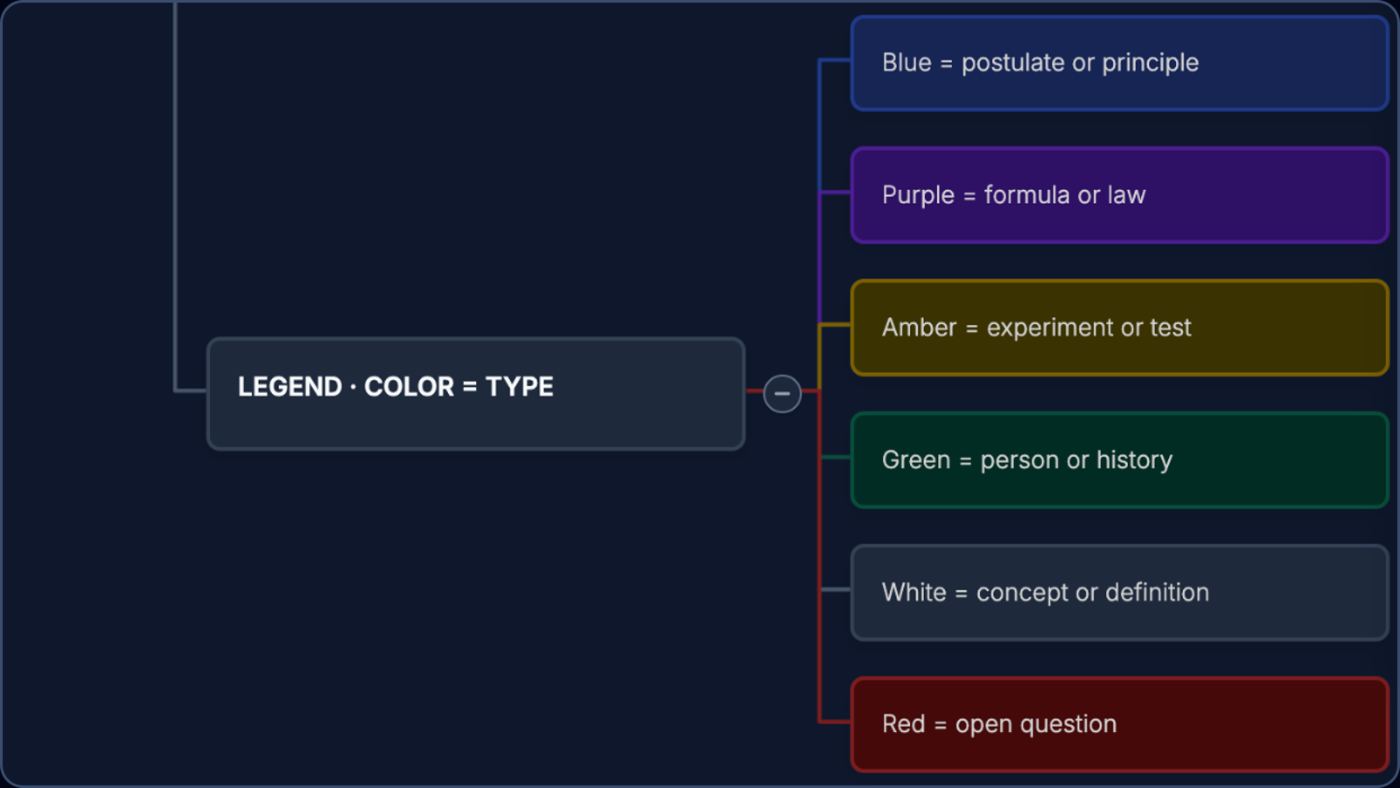
Decide what each colour stands for before you start, and let it depend on the material. For a physics text the legend might be: blue for principles, purple for formulas and laws, amber for experiments, green for people and history, white for definitions, red for open questions. For law you might separate rules, exceptions and cases. For a language, vocabulary, grammar and examples.
Two things make a legend work. Keep it short, because you will not remember ten categories. And keep it the same for the whole subject, so that one glance at your map tells you what you have plenty of and what is missing. A topic with many definitions and no examples is a topic you can recite but not yet use.
In Nodebook: you can keep the legend on the map itself, as a few coloured nodes.
Try it: write your legend before you highlight anything.
3. Add one line: why does this matter?
This step is the easiest to skip and probably the one worth most. Asking yourself why a statement is true or why it matters, and explaining it in your own words, did better in the same review than highlighting did.
The line does not need to be elegant. It needs to be yours. Compare:
Weak: "This matters because it is important for relativity."
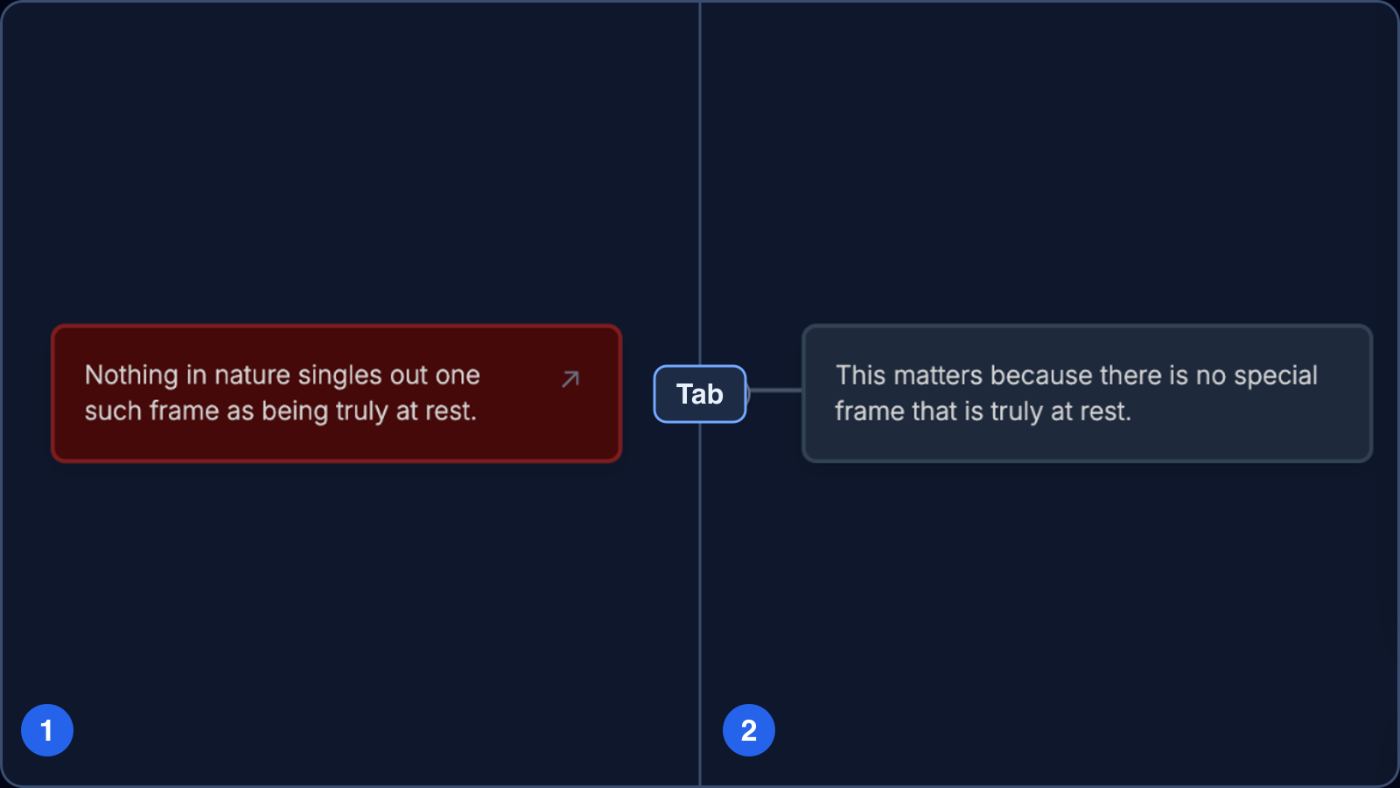
Better: "This matters because there is no special frame that is truly at rest."
The first one could be written under any sentence in the book. The second one forces you to restate the idea. If you can't finish the sentence, that is useful news: you have found something you don't understand yet, while the book is still open in front of you.
In Nodebook: select the node, press Tab to add a child, and write your line underneath. The author's words and yours stay side by side, and you can always tell which is which.
Try it: do it for every red highlight.
4. Go back to the source
A sentence pulled out of a page loses its surroundings: the condition that came before it, the exception that came after. A week later it is easy to remember a claim as stronger or broader than the author made it.
So treat every note as a door back to its page. Before you rely on it in an essay, an exam answer or a decision at work, open the passage and read a few sentences on either side.
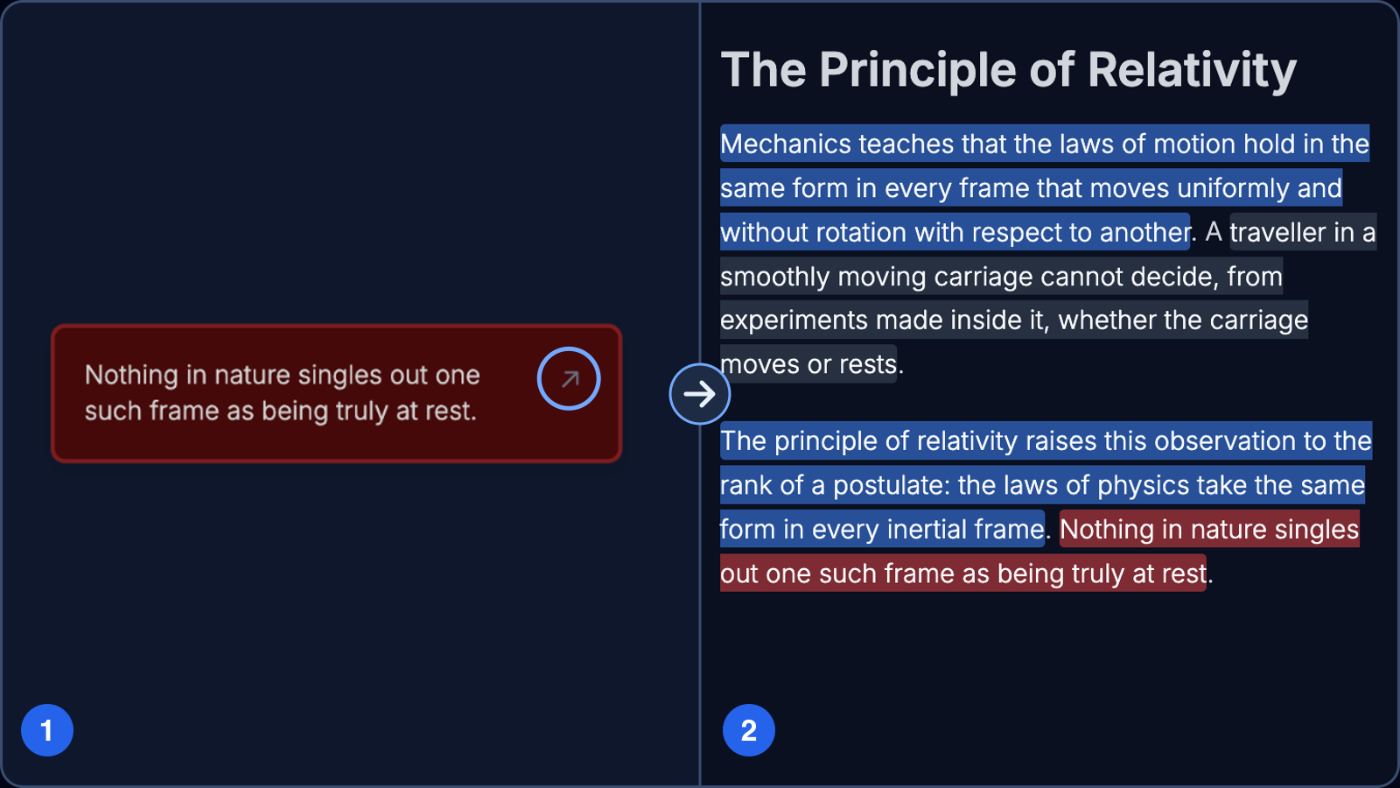
In Nodebook: every node made from a highlight keeps a link to its source. Click the small arrow on the node and the document opens at the passage.
Try it: before you close a document, open three of your notes at the source.
Put it together: a 25-minute session
- Spend 2 minutes writing your colour legend and skimming the headings.
- Read for 15 minutes. Finish each paragraph before you mark anything.
- Spend 5 minutes adding your own line under the highlights that matter most.
- Spend the last 3 minutes with the book closed. Look only at your highlights and try to explain each one, then check the source where you hesitate.
That last step is a small version of testing yourself. Tomorrow, try the explanations again before you read anything new. In Nodebook, a node that has a title and text also works as a flashcard, so a question as the title and your own line as the answer gives you something to come back to.
The goal was never a colourful page. It is being able to close the book and still say what was in it.